
The India-UK Comprehensive Economic and Trade Agreement (CETA), formally signed on July 24, 2025, represents a landmark achievement in the bilateral economic relationship between two of the world’s leading economies. Described by the UK government as its “biggest and most economically significant new bilateral FTA since leaving the EU,” the agreement is projected to double bilateral trade to 100 billion by 2030 and increase the UK’s long-run GDP by 0.13%, or £4.8 billion. While the elimination of tariffs on nearly 99% of India’s exports to the UK is a key benefit, the true strategic innovation lies in the CETA’s flexible and modern Rules of Origin (ROO) framework.
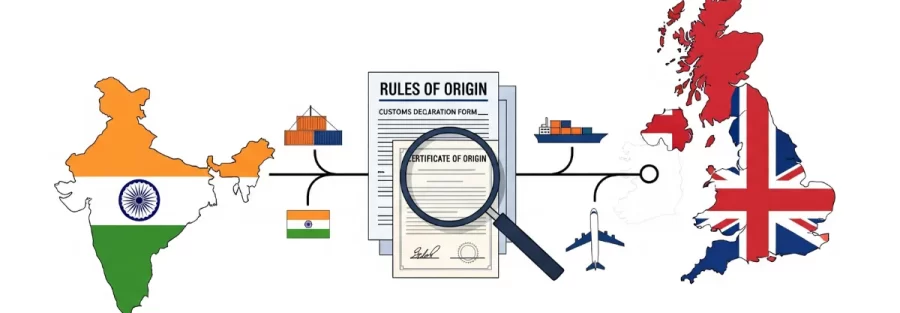
Rules of Origin are the foundational criteria that determine a product’s national source, ensuring that only goods genuinely originating from an agreement partner receive preferential, reduced, or zero-duty access. This framework also serves as a critical safeguard, preventing third-party countries from routing their goods through a member nation to illegitimately claim tariff benefits. The CETA’s ROO framework is designed for the complexities of 21st-century global supply chains, where components and raw materials often come from multiple countries.
Decoding the Core Principles of Rules of Origin
At the heart of any ROO framework is the distinction between two fundamental criteria for a good to be considered “originating”:
- Wholly Obtained: A product is classified as “wholly obtained” if it is exclusively produced in one of the CETA member countries without incorporating any materials from outside the UK or India . This typically applies to natural resources and agricultural products, such as minerals extracted from the soil or crops harvested from the land.
- Sufficiently Worked or Processed: This is the more common criterion, applying to products manufactured using materials from a non-member country . For such a product to be considered originating under the CETA, the manufacturing process in either the UK or India must be substantial enough to effect a fundamental change in the item’s form, nature, or character.
To prove that a product has been “sufficiently worked or processed,” businesses must meet one of the criteria detailed in the CETA’s Product Specific Rules of Origin (PSRs). These include:
- Change in Tariff Classification (CTC): This requires that the manufacturing process results in a change to the product’s Harmonized System (HS) tariff classification code.
- Qualifying Value Content (QVC): This rule sets a minimum percentage of the final product’s value that must be derived from originating materials or processing within the exporting country.
- Specific Manufacturing or Processing Operations: This is the most prescriptive rule, outlining the exact production processes that must occur within the exporting country.
The CETA also employs full bilateral cumulation, a significant feature that allows producers to count materials and production processes from both the UK and India toward meeting the ROO criteria . This provision provides flexibility for businesses, as they can source inputs from either CETA partner without losing preferential trade status.
The CETA’s Innovative ROO Framework
The India-UK CETA introduces several first-of-their-kind features for an Indian trade agreement, creating a streamlined, trust-based model for compliance.
- The “Coequal” Rule: This innovative provision allows a producer to qualify for CETA benefits by meeting any one of the multiple origin criteria—be it the Change in Tariff Classification (CTC), the Qualifying Value Content (QVC) threshold, or specific manufacturing operations . This marks a significant departure from India’s earlier FTAs, which typically relied on a single, more rigid criterion, and provides unprecedented flexibility for sectors like chemicals, pharmaceuticals, and auto components .
- Self-Certification and Importer’s Knowledge: The agreement empowers Indian exporters to self-certify the origin of their goods on their own, without the need for a third-party verification body.5 This measure streamlines documentation and lowers export costs. On the UK side, a reciprocal provision allows importers to rely on an “importer’s knowledge” clause to certify the origin themselves . This fosters trust between trading partners and reduces delays at the border.
- Low-Value Waiver: The CETA provides a critical waiver for low-value consignments, exempting them from extensive origin documentation. This waiver applies to shipments valued below Rs. 1,17,143 (approximately US$ 1,354), making it a major boon for Micro, Small, and Medium Enterprises (MSMEs) and e-commerce businesses that frequently ship small packages.
Sectoral Impact Analysis
The CETA’s ROO and tariff reductions are poised to have a transformative impact on key sectors, providing new market access and a competitive edge.
- Textiles and Apparel: The CETA provides duty-free access for 99% of Indian textile and apparel exports to the UK, effectively leveling the playing field with competitors like Bangladesh and Vietnam who already enjoyed zero-duty access . This is expected to spur large-scale employment generation and expand India’s market share in the UK.
- Gems and Jewellery: The agreement offers a two-pronged benefit. It eliminates the 2.5-4% import duties on Indian plain gold and diamond jewellery exports to the UK. Secondly, it slashes duties on precious metal bullion imports from the UK, with gold and platinum bars facing zero duties. The Product Specific Rule of Origin for gold jewellery requires a change in tariff sub-heading (CTSH) and a Qualifying Value Content (QVC) of not less than 3.5% for plain jewellery and up to 7% for studded jewellery.
- Automotive and Auto Components: For the first time in any free trade agreement, India has agreed to reduce tariffs on the auto sector. The CETA introduces a Tariff Rate Quota (TRQ) system for UK-built vehicles, which will see tariffs on luxury cars (over 3000cc petrol or 2500cc diesel) reduced from over 100% to 10% over 15 years within a quota . The Product Specific Rules of Origin for auto parts require a change in tariff heading (CTH) or a Qualifying Value Content (QVC) of at least 40%.
Strategic Advantage: CETA vs. India-UAE CEPA
The India-UK CETA represents a significant evolution in India’s approach to trade agreements when compared to the India-UAE Comprehensive Economic Partnership Agreement (CEPA). While the CEPA was a landmark deal, the CETA builds on its foundation with a more advanced framework.
A key difference is the compliance model. The India-UAE CEPA relied on a Certificate of Origin issued by authorized agencies and included provisions for pre-export verification and factory visits. The CETA, however, moves to an immediate self-certification model, a trust-based system that allows exporters to declare origin on their own and UK importers to utilize the “importer’s knowledge” clause from day one. This reflects a deeper level of mutual trust and a commitment to digital-first trade. Furthermore, the CETA’s “coequal” rule provides a level of flexibility not present in the India-UAE CEPA, which primarily uses twin criteria of a Change in Tariff Classification (CTC) and a Qualifying Value Content (QVC).
Practical Roadmap for Businesses
The CETA’s benefits are contingent on a clear understanding of its rules. Businesses must proactively adapt their strategies to leverage the opportunities. Indian exporters must first accurately classify their product using its Harmonized System (HS) code. They can then consult the CETA’s official Product Specific Rules of Origin to determine which single criterion (CTC, QVC, or specific processing) their product must meet for preferential treatment. The new self-certification process means exporters can make a simple declaration of origin on their invoice or other commercial documents. UK importers can use the “importer’s knowledge” clause by ensuring their Indian suppliers provide detailed production records, invoices, and supplier declarations to prove origin.
This dynamic agreement, with its phased tariff reductions and innovative ROO framework, is a blueprint for future trade relations. By understanding and strategically adapting to these rules, businesses can optimize their supply chains, reduce costs, and secure a competitive advantage in the new trade landscape.