
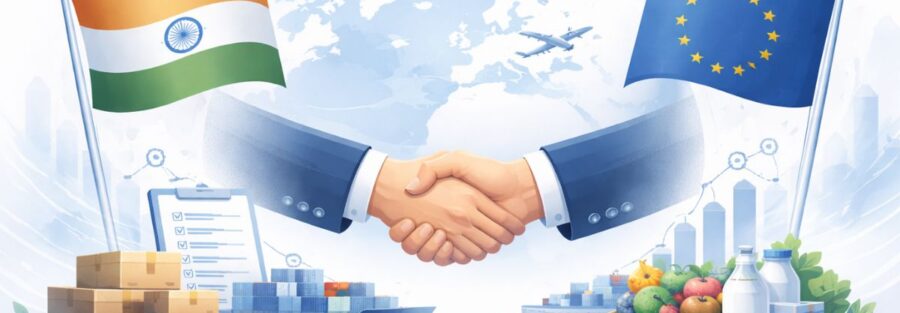
India and the European Union are moving closer to finalising a long-awaited Free Trade Agreement (FTA) that could significantly reshape bilateral trade and investment flows. Given the size of both economies, this agreement is being viewed as one of the most consequential trade partnerships India has pursued in recent years.
As global trade patterns shift and supply chains diversify, the India–EU FTA is expected to create new opportunities for businesses while strengthening economic cooperation between the two regions.
India–EU Trade Relationship: The Bigger Picture
The European Union is one of India’s largest trading partners, accounting for a substantial share of India’s exports and imports. Trade between India and the EU spans key sectors such as engineering goods, pharmaceuticals, textiles, chemicals, machinery, and services.
Despite strong trade ties, existing tariff and non-tariff barriers have limited the full potential of this relationship. The proposed FTA aims to address these challenges and provide a more predictable and transparent trade framework.
What Is the India–EU Free Trade Agreement?
The India–EU Free Trade Agreement is a comprehensive trade pact designed to:
- Reduce or eliminate customs duties
- Improve market access for goods and services
- Promote bilateral investment
- Strengthen regulatory cooperation
- Support sustainable and inclusive trade
The agreement also covers areas such as intellectual property, digital trade, labour standards, and environmental commitments.
Key Areas Covered Under the Agreement
1. Trade in Goods
The FTA is expected to significantly lower tariffs on a wide range of products. Indian exporters could benefit from improved access to the EU market for:
- Textiles and apparel
- Pharmaceuticals and medical devices
- Engineering and auto components
- Chemicals and processed foods
For EU exporters, the agreement may open greater access to the Indian market for:
- Machinery and industrial equipment
- Automobiles and auto parts
- High-value agricultural and food products
- Renewable energy technologies
2. Trade in Services
Services are a key focus area, especially for India. The FTA is expected to create opportunities in:
- IT and software services
- Professional and business services
- Financial services
- Education and research collaboration
Greater mobility of professionals and mutual recognition of qualifications are also under discussion.
3. Investment and Market Access
The agreement aims to encourage two-way investments by offering:
- Stronger investor protection
- Transparent dispute resolution mechanisms
- Improved regulatory certainty
This could enhance long-term investment flows and joint ventures across sectors.
4. Sustainability and Compliance
The EU places strong emphasis on sustainability, labour rights, and environmental standards. The FTA is expected to integrate:
- Climate-related commitments
- Responsible supply chain practices
- Compliance with environmental and social norms
For Indian exporters, this will require greater focus on ESG compliance and documentation.
Opportunities for Indian Businesses
The India–EU FTA can provide Indian exporters with:
- Reduced tariff costs, improving price competitiveness
- Access to one of the world’s largest consumer markets
- Opportunities to integrate into EU supply chains
- Greater certainty in long-term trade planning
MSMEs stand to benefit through simplified procedures and improved access to high-value markets.
Challenges and Considerations
While the FTA offers significant advantages, businesses must also prepare for:
- Stricter regulatory and quality standards
- Enhanced documentation and compliance requirements
- Competition from EU imports in sensitive sectors
A balanced approach is essential to ensure domestic industries remain competitive while benefiting from market access.
Strategic Importance of the India–EU FTA
Beyond trade volumes, the agreement holds strategic importance. It strengthens India’s engagement with Europe at a time when global trade alliances are being redefined. For the EU, India represents a fast-growing market and a reliable partner in diversifying supply chains.
Conclusion
The India–EU Free Trade Agreement has the potential to transform bilateral trade, deepen economic cooperation, and create long-term opportunities for businesses on both sides. As negotiations progress, exporters and importers should stay informed, review their supply chains, and prepare for new compliance requirements.
For Indian businesses willing to adapt, the India–EU FTA could become a gateway to sustainable growth in the global marketplace.