

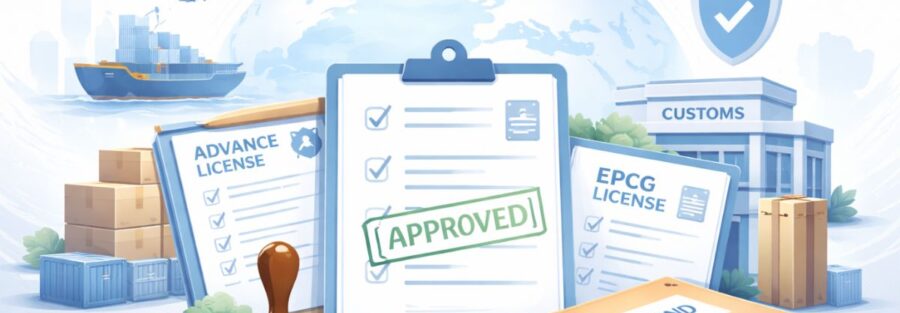
Export promotion schemes such as Advance Authorisation and EPCG (Export Promotion Capital Goods) play a vital role in reducing import costs for exporters. While fulfilling the export obligation (EO) is the primary requirement under these schemes, the compliance process does not end there.
Once the export obligation is completed and the EODC (Export Obligation Discharge Certificate) is issued by DGFT, the final and crucial step is bond closure with Customs. This article explains the bond closure process after EODC, its importance, and key compliance requirements.
Understanding the Role of EODC and Bond Closure
When an Advance Authorisation or EPCG licence is issued, the importer executes a bond or LUT with Customs, backed by bank guarantee in some cases. This bond safeguards revenue by ensuring compliance with licence conditions.
The compliance lifecycle follows this order:
- Import under licence
- Fulfilment of export obligation
- Issuance of EODC by DGFT
- Bond closure with Customs
While EODC confirms completion of export obligation, bond closure formally releases the exporter from customs liability.
Why Bond Closure After EODC Is Important
Bond closure is not automatic after EODC. Exporters must separately approach Customs to complete this step. Without bond closure:
- The bond continues to appear as open in customs records
- Bank guarantees may remain blocked
- Future imports or licences may face compliance scrutiny
- Exporters may receive customs notices despite having EODC
Therefore, bond closure ensures final compliance and closure of the licence cycle.
Bond Closure Process for Advance Authorisation
Step 1: Obtain EODC from DGFT
Once export obligation is fulfilled, the exporter applies on the DGFT portal and obtains the EODC.
Step 2: Prepare Bond Closure Documents
Commonly required documents include:
- Copy of Advance Authorisation licence
- Original EODC issued by DGFT
- Import bills of entry
- Export shipping bills
- BRCs / eBRCs
- Copy of executed bond or LUT
Step 3: Submit Application to Jurisdictional Customs
The bond closure request is submitted to the customs authority where the bond was executed, along with all supporting documents.
Step 4: Customs Verification
Customs verifies:
- Imports against the licence
- Export fulfillment as per EODC
- Correlation between imports and exports
Step 5: Bond Discharge
Upon satisfactory verification, Customs discharges the bond and issues a bond closure confirmation, officially closing the licence at customs level.
Bond Closure Process for EPCG Licence
For EPCG licences, the process is similar but involves additional checks.
Key EPCG-Specific Aspects
- Capital goods installation and usage may be verified
- Export obligation is calculated based on duty saved value
- EODC must clearly mention full EO fulfillment
Process Flow
- Obtain EPCG EODC from DGFT
- Submit bond closure request to customs
- Provide installation certificate, if applicable
- Customs verifies capital goods and EO details
- Bond and bank guarantee are formally released
Common Reasons for Delay in Bond Closure
- EODC not submitted to customs
- Mismatch between EODC and shipping bills
- Pending BRCs or unrealised export proceeds
- Bond executed at a different port than closure request
- Incomplete documentation
Early reconciliation helps avoid unnecessary delays.
Best Practices for Smooth Bond Closure
- Apply for bond closure immediately after EODC issuance
- Keep import-export data well reconciled
- Maintain copies of all customs and DGFT communications
- Track bond status with customs periodically
- Coordinate with banks for timely submission of BRCs/eBRCs
Conclusion
Bond closure is the final compliance step after receiving EODC under Advance Authorisation and EPCG schemes. While DGFT certifies export obligation fulfillment, Customs bond closure formally ends the licence liability.
Exporters who complete this process on time ensure clean compliance records, faster release of bank guarantees, and smoother access to future export incentives.