


India’s export compliance landscape is continuing to evolve, and one of the most significant developments for service exporters is the introduction of Form EDF (Export Declaration Form) by the Reserve Bank of India (RBI).
With service exports becoming an increasingly important contributor to India’s economy, RBI has introduced Form EDF to bring greater transparency, standardization, and monitoring of foreign exchange realization. The new framework aligns service exports with a more structured reporting mechanism and strengthens overall export compliance.
For businesses exporting services, understanding the purpose of Form EDF and preparing for its implementation will be essential.
What is Form EDF?
Form EDF, or Export Declaration Form, is a declaration that captures essential details relating to an export transaction. The information submitted through this form enables Authorized Dealer (AD) Banks and regulatory authorities to monitor export proceeds and ensure compliance with FEMA regulations.
While export declarations have traditionally been associated with physical exports of goods, the introduction of Form EDF extends a similar compliance framework to service exports.
This represents a significant shift in how service export transactions will be reported and monitored.
Why Has RBI Introduced Form EDF?
The services sector has witnessed rapid growth across industries such as IT, software development, consulting, engineering, financial services, design, and professional services.
As export volumes have increased, there has been a growing need for a standardized mechanism to capture service export transactions and monitor the realization of export proceeds.
The introduction of Form EDF aims to:
- Create a structured reporting process for service exports.
- Improve monitoring of export proceeds through banking channels.
- Enhance transparency in foreign exchange realization.
- Strengthen compliance under FEMA.
- Support accurate reconciliation under the EDPMS framework.
Overall, the objective is to establish a more consistent compliance process for service exporters.
How Does Form EDF Fit into the EDPMS Framework?
One of the most important aspects of Form EDF is its connection with the Export Data Processing and Monitoring System (EDPMS).
The information declared through Form EDF will help AD Banks monitor export transactions and reconcile export proceeds received from overseas customers.
This will create a more streamlined compliance process by linking:
- Service export declarations
- Export invoices
- Foreign remittances
- Export realization records
A structured declaration process also helps reduce reconciliation gaps and improves the accuracy of banking records.
What Will This Mean for Service Exporters?
The introduction of Form EDF will require service exporters to adopt a more disciplined approach to export documentation and reporting.
Businesses will need to ensure that:
- Service export details are accurately declared.
- Export invoices are properly maintained.
- Foreign remittances are monitored regularly.
- Documentation is consistent across banking and accounting records.
- Export proceeds are tracked until realization.
For many companies, this will require strengthening internal compliance processes and improving coordination between finance, export, and banking teams.
Challenges Businesses May Face
As with any new compliance requirement, businesses may experience certain operational challenges during implementation.
Understanding the New Reporting Process
Many service exporters have not previously dealt with export declaration requirements. Understanding when and how Form EDF needs to be submitted will be an important first step.
Documentation Readiness
Companies will need to maintain accurate and complete documentation supporting every service export transaction. Missing or inconsistent records can create reconciliation issues later.
Banking Coordination
Since AD Banks will play a central role in processing and monitoring Form EDF information, businesses will need to establish effective communication with their banking partners.
Managing Higher Transaction Volumes
Organizations handling a large number of service export invoices every month may find manual documentation and tracking increasingly difficult.
How Businesses Can Prepare
Although the introduction of Form EDF brings additional compliance responsibilities, early preparation can make the transition much smoother.
Service exporters should consider:
- Reviewing existing documentation practices.
- Standardizing invoice and record management.
- Maintaining proper records of foreign remittances.
- Coordinating proactively with AD Banks.
- Implementing systems that simplify export documentation and reconciliation.
Businesses that establish structured compliance processes today will be better positioned to manage future regulatory requirements.
The Growing Role of Automation
As export compliance becomes increasingly digital, many organizations are moving towards automation to manage documentation and reconciliation more efficiently.
Automated compliance solutions can help businesses:
- Organize export documentation.
- Improve reconciliation accuracy.
- Monitor export proceeds more effectively.
- Reduce manual intervention.
- Strengthen overall compliance management.
Automation not only improves operational efficiency but also minimizes the risk of errors that commonly occur in manual processes.
Conclusion
The introduction of Form EDF marks an important milestone in India’s export compliance framework for service exporters. By introducing a structured declaration process, RBI aims to improve transparency, strengthen monitoring of export proceeds, and create a more streamlined compliance ecosystem.
While businesses may need to adapt their documentation and reporting processes, those that prepare early and adopt structured compliance practices will find themselves better equipped to meet evolving regulatory expectations.
As India’s services sector continues to expand globally, robust compliance will play an increasingly important role in ensuring smooth and sustainable export growth.
Annexure – Form EDF Format
For better understanding, below is the prescribed Form EDF (Export Declaration Form) introduced by the Reserve Bank of India.
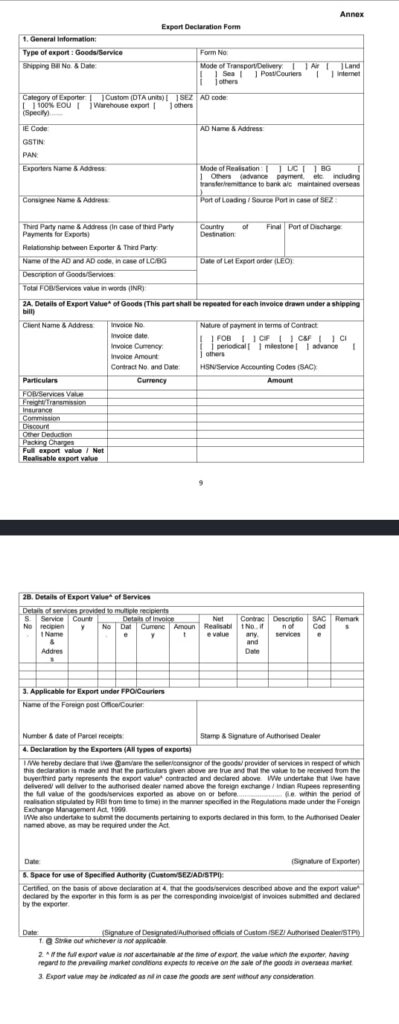
Figure: Annexure – Form EDF (Export Declaration Form) prescribed by the Reserve Bank of India.