
The India-UK Comprehensive Economic and Trade Agreement (CETA), signed on July 24, 2025, represents a watershed moment for Indian exporters seeking to expand their presence in the lucrative UK market. This landmark agreement provides duty-free access for 99% of India’s exports to the UK, covering nearly 100% of trade value. Understanding which specific HSN codes benefit from this duty elimination is crucial for exporters looking to capitalize on these new opportunities.
Understanding the CETA Framework
Under CETA, the UK eliminates tariffs on approximately 99% of tariff lines for Indian goods, while India reciprocally reduces duties on 90% of UK tariff lines. The agreement uses a staging category system where products marked with category ‘A’ receive immediate duty-free access upon the agreement’s entry into force, while other categories follow phased elimination schedules over 5-15 years.
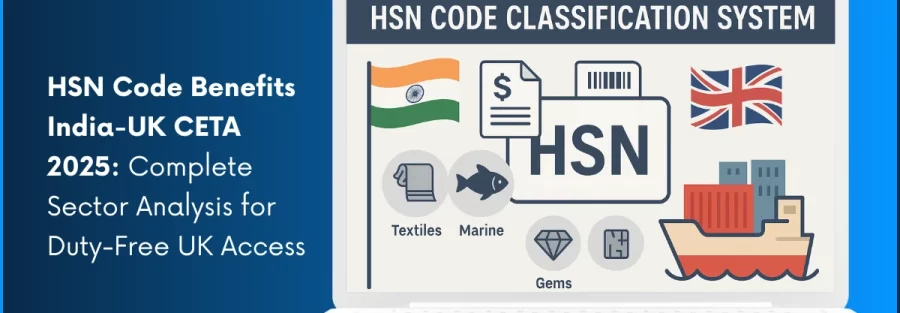
Textiles and Apparel: Comprehensive Coverage Under Chapters 50-63
The textile sector emerges as one of the biggest beneficiaries under CETA, with all 1,143 textile product categories receiving zero-duty access to the UK market. This comprehensive coverage spans across multiple HSN chapters:
Chapter 50 – Silk Products
All silk-related products under Chapter 50 receive duty-free access, including:
- 5001: Silk-worm cocoons suitable for reeling
- 5002: Raw silk (not thrown)
- 5003: Silk waste including cocoons unsuitable for reeling
Chapter 51 – Wool and Animal Hair
Wool and animal hair products benefit from complete tariff elimination:
- 5101: Wool, not carded or combed
- 5102: Fine or coarse animal hair, not carded or combed
- 5111-5113: Woven fabrics of wool and animal hair
Chapter 52 – Cotton Products
Cotton exports, crucial for India’s textile economy, gain comprehensive access:
- 5201: Cotton, not carded or combed
- 5208-5212: Woven fabrics of cotton at various weight specifications
- 5204-5207: Cotton yarns and sewing threads
Chapter 53 – Other Vegetable Textile Fibres
Products including jute, flax, and other plant fibres receive zero duties:
- 5301: Flax, raw or processed but not spun
- 5302: True hemp (Cannabis sativa L.)
- 5311: Woven fabrics of other vegetable textile fibres
Chapters 54-63 – Man-made Fibres and Made-up Articles
The agreement covers the entire spectrum of synthetic textiles and finished products:
- Chapters 54-55: Synthetic and artificial filaments and staple fibres
- Chapters 56-60: Special textiles, carpets, and knitted articles
- Chapters 61-63: Clothing, accessories, and other made-up textile articles
Previously, Indian textile exports faced UK duties of up to 12%, putting them at a competitive disadvantage against countries like Bangladesh and Pakistan. The elimination of these tariffs levels the playing field and is expected to increase India’s UK market share by approximately 5%.
Marine Products: Complete Duty Elimination Under Multiple Chapters
The marine sector receives exceptional benefits under CETA, with all products in tariff category ‘A’ enjoying 100% duty-free access. The comprehensive coverage includes:
Chapter 03 – Fish and Crustaceans
All live, fresh, frozen, dried, and processed fish products gain zero-duty access:
- 0301: Live fish
- 0302: Fish, fresh or chilled
- 0303: Fish, frozen
- 0304: Fish fillets and other fish meat
- 0305: Fish, dried, salted or in brine; smoked fish
- 0306: Crustaceans (shrimp, prawns, lobsters, crabs)
- 0307: Molluscs (squid, cuttlefish, mussels)
Chapter 05 – Animal Products
Marine-related animal products benefit from tariff elimination:
- Coral, cowries, and Artemia used in aquaculture
- Marine shells and similar products
Chapter 15 – Animal and Vegetable Fats
Fish oils and marine fats receive duty-free treatment:
- 1504: Fish oils and their fractions
- 1516: Marine animal and vegetable fats
Chapters 1603-1605 – Prepared Seafood
Value-added marine products gain competitive advantages:
- 1603: Extracts and juices of meat, fish or crustaceans
- 1604: Prepared or preserved fish
- 1605: Crustaceans, molluscs and other aquatic invertebrates, prepared
Chapter 23 – Residues and Feed
Marine-based feed products benefit from zero duties:
- Fish meal, fish and shrimp feed
- Residues used in animal fodder
Chapter 95 – Toys and Sports Goods
Fishing equipment receives duty-free access:
- 9507: Fishing rods, hooks, reels, and other fishing gear
Previously, these marine products faced UK tariffs ranging from 0% to 21.5%. The elimination of these duties is projected to boost Indian marine exports to the UK by 70%, with potential to triple exports from the current $104 million to over $300 million.
Gems and Jewellery: Strategic Access Under Chapter 71
The gems and jewellery sector, accounting for $941 million in UK exports in 2024, receives significant benefits under Chapter 71. However, the agreement strategically protects certain sensitive areas:
Chapter 71 – Natural and Cultured Pearls, Precious Stones
Coverage includes:
- 7101: Natural or cultured pearls
- 7102: Diamonds (with specific conditions)
- 7103: Precious stones other than diamonds (rubies, sapphires, emeralds)
- 7104: Synthetic or reconstructed precious stones
- 7108: Gold in various forms
- 7113: Articles of jewellery and parts thereof
Notably, lab-grown diamonds and gold jewellery remain in India’s exclusion list to protect domestic manufacturers. Traditional gems and worked jewellery items receive preferential treatment, positioning Indian exporters to capture a larger share of the UK’s premium jewellery market.
Agriculture and Food Processing: Extensive Coverage
Over 95% of agricultural and processed food tariff lines receive zero-duty access, covering:
Spices and Traditional Products
- 0904: Pepper (Piper spp.)
- 0907: Cloves
- 0908: Nutmeg, mace, and cardamoms
- 0910: Ginger, saffron, turmeric, thyme, bay leaves
Processed Foods
- 0804: Dates, figs, pineapples, mangoes
- 2001: Vegetables, fruit, nuts prepared or preserved by vinegar
- 2103: Sauces and preparations (including pickles and chutneys)
Previously facing tariffs up to 70%, these products now enter the UK market duty-free, enhancing their competitiveness against global competitors.
Engineering and Chemicals: Strategic Industrial Coverage
Automotive Components – Chapter 87
Selected automotive parts receive preferential treatment:
- 8708: Parts and accessories for motor vehicles
- Electric vehicle components under specific tariff rate quotas
Aerospace – Chapter 88
Complete liberalization for aerospace products:
- 8802: Powered aircraft
- 8803: Parts of aircraft and spacecraft
Previously facing duties up to 11%, aerospace products now enjoy zero-tariff access.
Organic Chemicals – Chapter 29
Chemical exports benefit from duty elimination:
- Various organic chemical compounds
- Pharmaceutical intermediates and active ingredients
Pharmaceutical Products – Chapter 30
Medical and pharmaceutical products receive immediate tariff elimination:
- 3003: Medicaments mixed but not in dosage form
- 3004: Medicaments in dosage form
Protected and Excluded Sectors
While CETA offers extensive liberalization, India strategically protected sensitive sectors through exclusions and extended phase-out periods:
Excluded Items
- Smartphones (HSN 85171300) remain completely excluded
- Tea and coffee (maintaining 110% duties)
- Gold and certain jewellery categories
- Lab-grown diamonds
Gradual Phase-out (5-10 years)
- Basic mobile phones (HSN 85171400) – 10-year protection
- PLI sector products including white goods and electronics
- Certain automotive components
Implementation Timeline and Compliance
The agreement follows a phased implementation approach:
Immediate Benefits (Category A)
Products marked ‘A’ receive zero-duty access from the date of entry into force, including most textiles, marine products, and agricultural goods.
Staged Implementation
Other products follow 5, 7, 10, or 15-year phase-out schedules, allowing domestic industries time to adapt while gradually opening markets.
Strategic Implications for Exporters
The HSN code-wise analysis reveals several strategic opportunities:
High-Impact Sectors
- Textiles: Complete tariff elimination across all chapters (50-63)
- Marine Products: Zero duties on all major export categories
- Agriculture: 95% coverage with immediate benefits
- Gems & Jewellery: Strategic access while protecting domestic interests
Competitive Advantages
The duty elimination particularly benefits labor-intensive sectors where India has natural competitive advantages, supporting the government’s job creation objectives.
Market Access Enhancement
With comprehensive coverage across traditional export strengths, Indian exporters can compete on equal terms with other FTA beneficiaries like Vietnam and Singapore.
Rules of Origin Requirements
To qualify for preferential treatment, products must meet specific Rules of Origin criteria:
- Wholly obtained goods
- Goods entirely produced using Indian or UK materials
- Goods meeting product-specific origin rules with value addition requirements
The agreement includes “co-equal” rules allowing exporters to choose between different qualifying criteria, providing flexibility in compliance.
Conclusion
The India-UK CETA’s HSN code-wise benefits create unprecedented opportunities for Indian exporters across multiple sectors. With 99% tariff line coverage and immediate benefits for key export categories, the agreement positions Indian businesses to significantly expand their UK market presence.
The strategic approach of protecting sensitive domestic sectors while liberalizing export-oriented industries demonstrates India’s mature trade negotiation capabilities. For exporters, understanding these specific HSN code benefits and compliance requirements will be crucial for capitalizing on the estimated $25.5 billion annual trade increase projected under CETA.
Success under this agreement will require exporters to align their product classifications, ensure Rules of Origin compliance, and leverage the comprehensive duty elimination to compete effectively in the UK’s demanding but lucrative market.